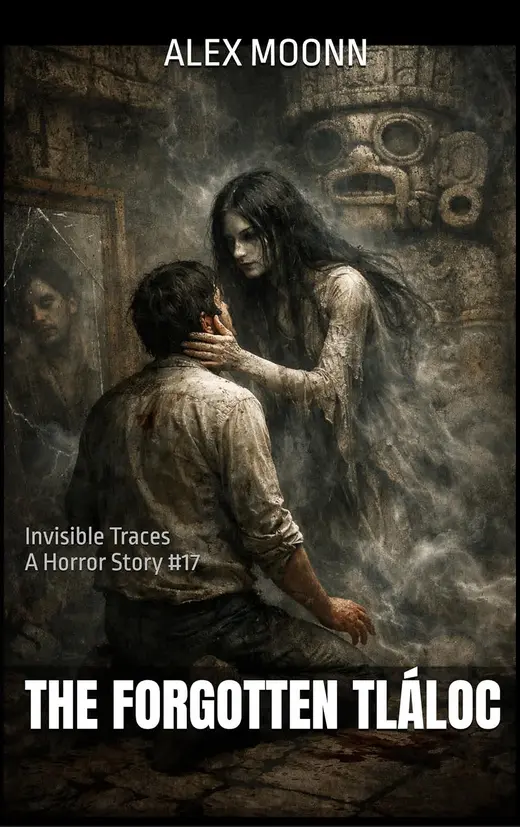
Invisible Traces · A Horror Story No. 17
The Forgotten Tláloc
Alex Moonn
Grief that finds no name becomes a cult.
Oaxaca, 1901. Linguist Rodrigo Villanueva believes that to name is to invoke, and that languages don't die, they just fold inward and wait. He goes to Oaxaca because of Inés, the wife who corrected his French and who, in the last two years of her life, was consumed by a figure that kept recurring in the friezes of Monte Albán. In Building J there is a chamber sealed by unknown hands. Years later, his sister Catalina would say he came back from Oaxaca different.
English edition, available on Amazon.
Read an excerpt
Oaxaca has a smell. I learned that before anything else about it.
In the letters I sent Catalina, I tried to describe that smell twenty different ways and none of them came close. The nearest I got: the smell of an unkept promise. Not wet earth before rain, not smoke from clay stoves on rooftops in the morning. Something prior to all of that, which lived in a layer beneath the smell, beneath the color, beneath the sound of cathedral bells echoing through the valley in the afternoon.
Only later did I understand that smell was a warning.
It was 1901. I was thirty-two years old and had what Catalina called "his illness": a collection of obsessions with dead languages that my sister never quite understood and I never knew how to explain. It wasn't academic interest or scientific rigor. It was conviction. I believed that words carry the things they name. That to name is to invoke. That languages don't die—they just fold inward and wait.
English edition, available on Amazon.