Invisible Traces · A Horror Story No. 10
The Teeth Archive
Alex Moonn
They say the body forgets pain. That's what people say who have never found where it goes.
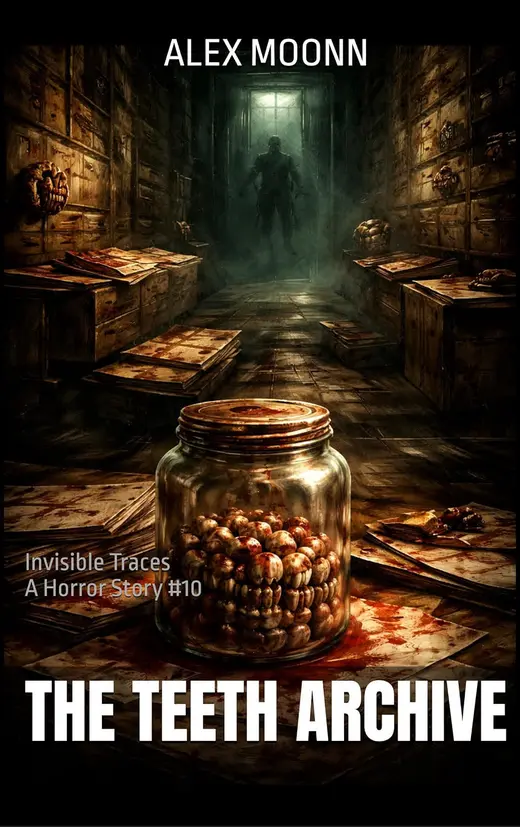
The Bremer Institute operated as a private sanatorium from 1901 to 1958, when it was shut down after a series of unexplained deaths. Archivist Heitor Vasques is hired to go through what is left of it, and deep in the northeast wing he finds record cards with no names, only numbers, written in the rust-colored ink of Dr. Erich Bremer. In one drawer, a child's tooth wrapped in a card bearing a single word: INGESTED.
English edition, available on Amazon.
Read an excerpt
I found the first tooth in a card-catalog drawer, deep in the northeast wing, on an oxidized metal shelf that groaned when I pulled it free, as if in protest. It was a molar, but too small to have belonged to an adult. The proportions were wrong: the root apices underdeveloped, the enamel still carrying the milky opacity you only find in a child’s primary teeth. It sat inside an identification card—no name, only a four-digit number written in that rust-colored ink I would come to associate with Dr. Erich Bremer—and a single word, in capitals: INGESTED.
I stood there staring at the tooth in my gloved palm for maybe a minute. It wasn’t curiosity. It was the kind of paralysis that happens when the brain receives information it doesn’t know how to file away—when you recognize that you’ve found something that shouldn’t exist but does, small and undeniable as a bone.
I put the tooth back in the drawer. Closed the drawer. Went to the bathroom in the upper hallway and washed my hands three times, each time with more soap, as if the problem were one of hygiene.
I went back to the third drawer the next morning.
There were more teeth.
English edition, available on Amazon.